

Throughout history, violence and murder have always been prevalent, as has the question of whether murder can ever be justified. There has always been intense debate around such an emotive topic, from the moral implications of taking a life whether in self-defence, vigilante justice, countries still using the death penalty or murder for other reasons. Is murder ever justified? Is there ever any just reason to take another human life? Vigilantism has always divided opinion: from the masked comic‑book crusaders to real‑world neighbourhood vigilante groups (such as the paedophile hunter groups seen on social media), the idea of an individual stepping outside formal justice systems to “set things right” is both alluring and troubling. But it raises deep philosophical questions such as “Who decides what justice looks like?”, “What moral authority does a lone individual possess?” and “Can violence ever be ethically justified?” William Ferraiolo’s The Ethical Assassin: A Vigilante’s Memoir dives headfirst into this moral quagmire, offering a provocative blend of philosophical reflection, personal confession and a darkly compelling narrative – it presents a protagonist who believes that some people simply need to die.
The Ethical Assassin: A Vigilante’s Memoir by William Ferraiolo follows the story of an anonymous protagonist who after the death of his entire family in a tragic accident his life has taken a drastic, deadly turn. The story is based around a found journal, a memoir of a serial killer, and gives details of several murders of victims that the anonymous author has deemed it necessary that they die for their crimes. After overhearing a conversation about a man boasting about how he physically abuses his wife and children, he decides this man must die – but it’s more than that, he NEEDS to die! This is the beginning of a descent into vigilante justice and contemplation about if there is a God or not, and the rights and wrongs of taking justice into your own hands.
This book isn’t written as a crime novel as such but the memoirs of a man detailing his crimes and his musings about his family, vigilantism and God (or if there is one). Keeping a journal of his murders, he meticulously documents each assassination, assassinations that he deems as ethical and necessary, while reflecting on the moral ramifications of his choices. His victims are not random; they are individuals he deems deserving of death due to their cruelty and corruption. Through his philosophical musings and introspection, the anonymous author and killer tries to make sense of why he has started on this journey of judge, jury and executioner.
Overall, this is a very different type of book – it is not written as a typical story but is constructed as a memoir of the private thoughts and musings of a self‑appointed vigilante who has dedicated his life to eliminating those he deems harmful to society (wifebeaters, child abusers etc.). It is a fascinating read, one that throws out many questions about vigilantism, whether violence and murder is ever justified, and if it is who decides?
The anonymous author, a vigilante with a taste for murder, comes across not as a unhinged killer, but more articulate, introspective and disturbingly rational. He is methodical and reasoned.
While not a book packed with action, it is gripping in the way it is written as it has a calm tone, almost academic, that discusses murder and the moral implications of his violent acts in a matter-of-fact way. It doesn’t just look at killing people who the author of the memoir has deemed that they need to die, they are not acts of uncontrolled rage, but is also a critique of societal apathy, institutional corruption and the moral cowardice of bystanders who allow evil to flourish. While you may not agree with his arguments, the questions and rationalisations raised are quite thought provoking.
The Ethical Assassin, while centred around vigilantism justice, challenges readers to confront uncomfortable questions about justice, responsibility and the limits of moral reasoning. It has a philosophical depth that really does make for interesting reading. While I wouldn’t describe it as an exciting read, it takes hold and keeps you reading, forcing you to think about the questions posed.
I couldn’t put it down and had to remind myself that it wasn’t a real memoir – or is it? With 122 pages, it isn’t a long novel but is a very thought-provoking philosophical one that is interesting reading.
Rating: 4/5
RRP: £9.99 (Paperback) / £7.74 (Kindle)
Available to buy from Amazon here.
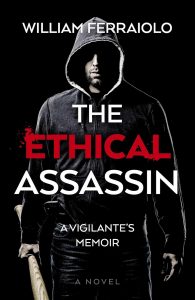 AUTHOR: William Ferraiolo
PUBLISHER: Roundfire Books
PUBLICATION DATE: 29 April 2025
ISBN: 978-1803417691
PRINT LENGTH: 122 Pages