

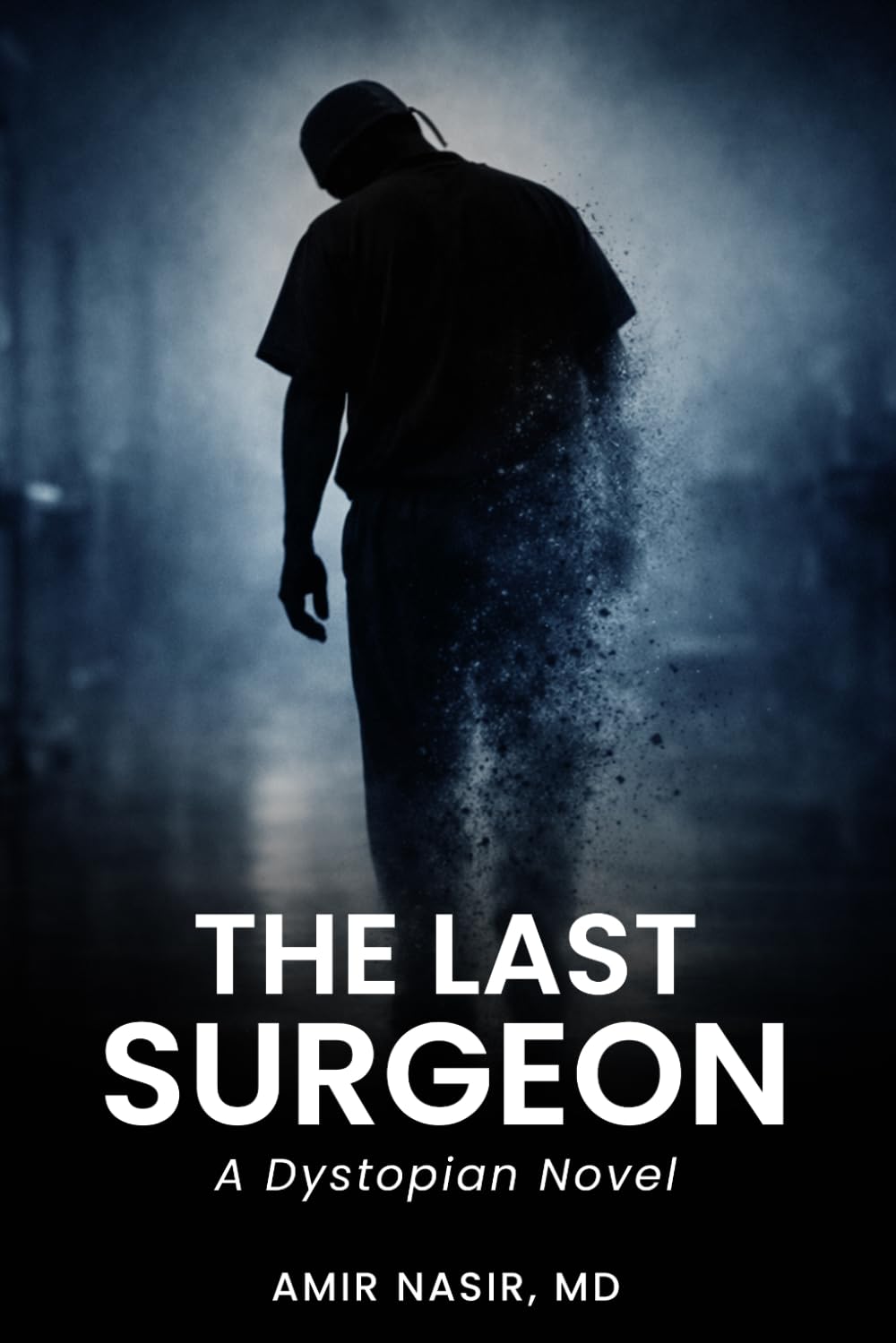
When you switch on the news these days, or read a news website, there is always something about Artificial Intelligence (AI). These news pieces contain reports with everything from hacking to medical breakthroughs, the good and the bad in the rapid rise of AI. But how far will it go? The Last Surgeon, by Amir Nasir, MD, looks at what happens when AI and robotics surpass the need for human interaction in medical care – is it a benefit, a hindrance or a dystopian nightmare?
We have all had to visit a GP or hospital in our lives and are used to seeing a whole lot of tech, even robotic equipment. But with AI rapidly advancing within the medical profession it has reshaped how we think about healthcare. From robotics assisting in some surgery and predictive diagnostics powered by machine learning, medicine is evolving at a pace that feels both exhilarating and unsettling. And AI is going to supercharge it. Welcome to The Last Surgeon, a fictional but very realistic imagining of one possible outcome in the rise of AI-assisted robots in the medical world.
The Last Surgeon is a dystopian novel and one that could be all to frighteningly real in the not too distant future. In this short novel we follow Dr David Halpern, a surgeon who has spent decades learning and honing his skills. With the hospital he works at needing to make cutbacks, AI machines are introduced in the hospital to handle paperwork, invoicing and general office duties, making a lot of administrative staff redundant. Soon robots are upgraded and introduced that now assist with diagnostics and general medical needs, replacing nurses, before starting to replace the much-skilled surgeons. These robots help reduce costs, effectively eliminate errors and perform procedures and complex operations more safely than their human counterparts.
Dr David Halpern survives the purge of doctors, surgeons and nurses, running his own practice for patients that want the more expensive care of human doctors. But as the days, months and years pass he slowly watches human staff being replaced entirely by robots and AI until the hospital is purely machine run, something that he thought would never happen, until he becomes the last surgeon remaining at the hospital.
Overall, I have really enjoyed reading The Last Surgeon. It is not a fast-paced thriller, but a story that slowly introduces the gradual introduction of AI and robots and how they take over jobs, but not in a malicious way. On one side it looks at positives such as how the new technologies bring down costs, make operations more efficient and with less errors, which in turn speeds up recovery time for patients and how it can almost eliminate waiting lists. But on the other side, it looks at how humans in the medical world (which will also relate to other professions) are made obsolete – all those years of training put to waste, the personal human interactions evaporating and empathy replaced with hyper-efficient faster, intelligent machines.
I enjoyed that the story doesn’t paint AI and robots as necessarily evil. While it delves into a word where technology takes over (not in a Terminator way) to make medical care more cost effective, efficient and better, it looks at the downsides of this while human oversight is stripped away. It isn’t a story of rogue machines and AI on a power trip, but more about the consequences of the technology doing the job it is designed to do extremely well.
The story isn’t faced-paced action, it’s not about humans fighting the machines. It travels along at a steady pace, the machines (aka Stella, Bella and Merlin) are gradually introduced as the tech progresses. And while based in the world of medical tech it isn’t packed with medical or tech jargon. The storytelling between the Halpern’s private and work life as well as the tech advances are very well balanced.
I enjoyed the story immensely. The writing was good but the premise of machines taking over doctors, nurses and surgeons was tangible – we already see automated self-check-in kiosks sitting there in GP surgeries, so it isn’t a big leap to imagine receptionists being entirely replaced by them. And robotics are already used in some surgeries so again it isn’t a big leap to see the tech advancing with AI to replace surgeons. This makes it an all too believable story and poses some very interesting questions such as how far do we take AI, robotics and automation? Would you be happy to have surgery performed entirely by a robot with any human oversight? Would you prefer robots instead of humans if it saved you a substantial sum of money and time if you had to pay for your care?
I thought that The Last Surgeon was a very good read and a thought-provoking story. It is not a long story at 140 pages but is definitely worth a read. A look at one possible future in the rise of AI, robotics and automation in medical care where a hospital no longer requires doctors or nurses.
Rating: 5/5
RRP: £8.99 (Paperback) / £2.95 (Kindle)
For more information, visit thelastsurgeon.org. Available to buy from Amazon here.